Multiple Choice
Identify the
choice that best completes the statement or answers the question.
|
|
|
1.
|
When Group 2A elements form ions, they
a. | gain two electrons. | b. | lose two electrons. | c. | gain two
protons. | d. | lose two protons. |
|
|
|
2.
|
Which of the folloiwng shows a
correct Lewis dot structure for the corresponding element?
|
|
|
3.
|
Which of the following would complete an ionic bond with
Calcium (Ca)?
|
|
|
4.
|
Why do atoms share electrons in covalent bonds?
a. | for nonmetals to attain a full valence energy level and become
stable | b. | to become more polar | c. | to become ions and attract each
other | d. | for metals and nonmetals to attain a full valence energy level and become
stable |
|
|
|
5.
|
Which of the following correctly provides the names and formulas of polyatomic
ions?
|
|
|
6.
|
Which of the following elements forms an ion with a 1– charge?
a. | fluorine | b. | potassium | c. | hydrogen | d. | sodium |
|
|
|
7.
|
What does the 3 represent in
the following electron configuration, 1s2 2s2 2p6 3s2
3p6?
a. | Electrons | c. | Sublevel | b. | Energy level of
electrons | d. | Orbitals |
|
|
|
8.
|
How many valence electrons does a helium atom have?
|
|
|
9.
|
Which of the following formulas represents an ionic compound?
|
|
|
10.
|
Which of the following correctly provides the name of the element, the symbol
for the ion, and the name of the ion?
a. | copper, Cu , carbonous ion , carbonous ion | b. | fluorine, F , fluoride ion , fluoride ion | c. | zinc, Zn ,
zincate ion ,
zincate ion | d. | sulfur, S , sulfide
ion , sulfide
ion |
|
|
|
11.
|
How are chemical formulas of ionic compounds generally written?
a. | Roman numeral first, then anion, then cation | b. | cation on left,
anion on right | c. | anion on left, cation on right | d. | subscripts first, then
ions |
|
|
|
12.
|
Which of the following is true about the composition of ionic compounds?
a. | They are formed from two or more nonmetallic elements. | b. | They are composed of
cations only. | c. | They are composed of anions only. | d. | They are composed of anions and
cations. |
|
|
|
13.
|
Which set of chemical name and chemical formula for the same compound is
correct?
a. | iron(III) oxide, Fe O O | b. | potassium chloride, K Cl Cl | c. | tin(IV) bromide,
Sn Br Br | d. | aluminum fluorate,
AlF |
|
|
|
14.
|
Which of the following best describes
Ca+2?
a. | Ca+2 is an anion because it has gained two
electrons
| c. | Ca+2 is a cation because it has gained 2
electrons | b. | Ca+2 is an anion because it has lost two
electrons | d. | Ca+2 is a cation because it has lost two
electrons |
|
|
|
15.
|
What is the correct formula for barium chlorate?
a. | BaCl | b. | BaClO | c. | Ba(ClO ) ) | d. | Ba(ClO ) ) |
|
|
|
16.
|
How many electrons does barium have to give up to achieve a noble-gas electron
configuration?
|
|
|
17.
|
How do atoms achieve full valence energy levels in single covalent bonds?
a. | Two atoms transfer electrons in a sea of mobile electrons | b. | Two atoms share two
electrons. | c. | One atom completely loses two electrons to the other atom in the
bond. | d. | Two atoms gain electrons and one element loses electrons while becoming
charged. |
|
|
|
18.
|
In which of the following is the number of neutrons correctly
represented?
a. |  U has 146 neutrons. U has 146 neutrons. | b. |  As has 108 neutrons. As has 108 neutrons. | c. |  F has 0
neutrons. F has 0
neutrons. | d. |  Mg has 24
neutrons. Mg has 24
neutrons. |
|
|
|
19.
|
Which of the following is considered a physical property of a substance?
a. | malleability | b. | reaction with an acid | c. | products of
decomposition | d. | ability to oxidize |
|
|
|
20.
|
Which of the following is a possible compound formed from
Cu+3 and NO3-1?
a. | Cu(NO) | c. | Cu(NO3)3 | b. | Cu2(NO3) | d. | Cu3(NO2) |
|
|
|
21.
|
Which of the following is a correct Lewis Dot Ion structure for potassium
chloride?
|
|
|
22.
|
What causes NH3 to have it’s shape, according to VSEPR
theory?
a. | the unusual location of the free electrons | b. | ionic attraction and
repulsion | c. | interaction between the fixed orbitals of the unshared pairs of
hydrogen | d. | repulsive forces between unshared pairs of electrons and
bonds |
|
|
|
23.
|
In which of the following is the name and formula given correctly?
a. | tin (IV) fluoride, SnF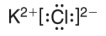 | b. | barium nitride,
BaN | c. | sodium oxide, NaO | d. | cobaltous chloride, CoCl |
|
|
|
24.
|
In the following compound: Iron (III) oxide, what does the
roman numerals indicate?
a. | The charge of the cation is +2 | c. | The charge of the cation is +3 | b. | The charge of the anion is
-2 | d. | The charge of the anion is -3 |
|
|
|
25.
|
What is the formula of a compound with aluminum oxide?
|
|
|
26.
|
Which of the following compounds is NOT an ionic
compound?
a. | CO2 | c. | Li(NO3) | b. | NaCl | d. | MgBr2 |
|
|
|
27.
|
When a metal reacts with a nonmetals, the metal tends to
-
a. | gain protons and form an anion | c. | gain electrons and from an anion | b. | lose protons and form a
cation | d. | lose electrons and form a cation |
|
|
|
28.
|
As wavelength increases, what happens to Frequency and
Energy?
a. | Frequency increases, Energy decreases | c. | Both Increase | b. | Both
Decrease | d. | Frequency decreases, Energy increases |
|
|
|
29.
|
Choose the correct Lewis Dot
Diagram for NaCl
|
|
|
30.
|
Brass is an alloy made of copper and zinc. To make brass copper is mixed
with zinc when both metals are at the liquid state. During the mixing process no chemical
reaction takes place. After mixing, brass appears to be uniform throughout. Brass must be
a(n):
a. | homogenous mixture | c. | an element | b. | heterogenous mixture | d. | pure substance |
|
|
|
31.
|
A sodium atom (Na) and a sodium ion (Na+) must
have the same number of -
a. | electrons | c. | protons | b. | Both protons and
electrons | d. | None of the above |
|
|
|
32.
|
Which of the following is the correct name for N  O  ? a. | dinitrogen pentoxide | b. | nitrate oxide | c. | nitrous
oxide | d. | nitrogen dioxide |
|
|
|
33.
|
How many valence electrons are in a silicon atom?
|
|
|
34.
|
One of the wavelengths emitted by hydrogen atoms is
6.56 x 10⁻⁷ m. Calculate
the frequency if the speed of light is 3.00 x 10⁸ m/s..
a. | 4.57 x 10⁻⁶ Hz | c. | 4.57 x 10¹⁴
Hz | b. | 4.57 x 10⁻⁷ Hz | d. | 1.97 x 10¹⁴ Hz |
|
|
|
35.
|
An example of an extensive property of matter is
a. | pressure. | b. | hardness. | c. | mass. | d. | temperature. |
|